
Shen Zhou
Ming painter who revived Yuan styles and was a central early master of the Wu School.

via Wikipedia: Asian art · see source
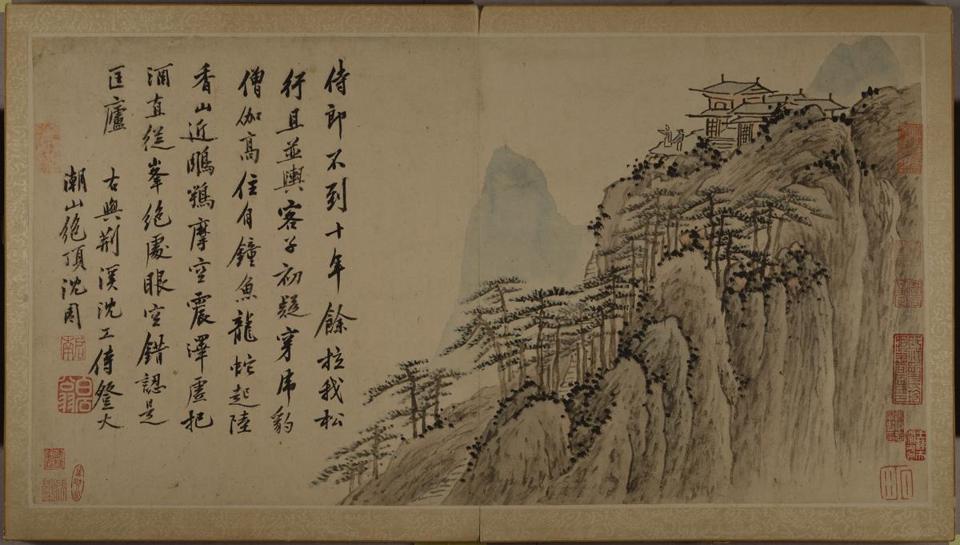
Born into a wealthy family in Xiangcheng, near Suzhou, he never pursued official examinations and devoted his life to painting, history, and the classics. His work revived Yuan dynasty styles and helped shape the Wu School, which emphasized painting as a meditative practice rather than a profession.
- known_for
- Key figure in the Wu School tradition; landscapes and ink paintings
Lore & Background
Shen Zhou was a key contributor to the Wu School, which arose in Suzhou after the Ming capital moved to Beijing, distancing imperial influence. He revered Yuan dynasty styles and combined them with experimental elements, often collaborating with literati friends on works that integrated painting, poetry, and calligraphy. He did not view paintings as commodities but as extensions of the painter. Notably, his family wealth was established earlier: his grandfather Shen Cheng was a notable landowner and collector during the early Ming.
Reader's Guide
Shen Zhou's significance lies in his role as a founder of the Wu School, which revived the ideal of the scholar-painter during the Ming dynasty. Living in Suzhou, away from the imperial court's Zhe School dominance, he and his colleagues used his collection of late Yuan and early Ming paintings as models for a revivalist approach. His work reflects a disciplined obedience to Yuan styles and Confucian values, yet incorporates experimental elements. By painting without need for patrons, he maintained artistic independence. His landscapes and 'boneless' flower paintings are his most famous works, and his influence extended through the Wu School's emphasis on painting as meditation. He is often contrasted with Wu Wei, who centered human figures in his art. Shen Zhou's legacy endures as a pivotal figure in Chinese painting history, bridging Yuan individualism and Ming scholarly traditions.
Did You Know?
- He never pursued official examinations, instead devoting his life to painting, history, and the classics.
- His grandfather Shen Cheng was a notable landowner and collector during the early Ming.
- He did not view paintings as commodities but as extensions of the painter.
Prehistoric Roots of Asian Art
The earliest traces of artistic expression in Asia stretch back to the Upper Paleolithic era, when modern humans first endured the harsh climates of Northeast Asia roughly forty thousand years ago. In northern Siberia, the Yana culture emerged around 31,000 BCE, and by approximately 21,000 BCE, two distinct cultural groups had taken shape: the Mal'ta culture along the Angara River near Lake Baikal, and the slightly later Afontova Gora-Oshurkovo culture. The Mal'ta people produced some of the continent's earliest known artworks, most notably small figurines carved from mammoth ivory. Dating to roughly twenty-three thousand years ago and rooted in the Gravettian tradition, these statuettes often feature stylized garments and clearly rendered faces. Because portable statuettes of this kind were previously thought to be almost exclusively a European phenomenon, scholars have speculated that Mal'ta may have maintained some form of cultural or ritual connection with European groups during that era, though this hypothesis remains unconfirmed. Excluding prehistoric works, the art of Mesopotamia stands as the oldest identifiable artistic tradition in Asia.
The Evolution of Chinese Painting and Calligraphy
Chinese visual art has evolved across millennia, shaped by successive dynasties, philosophical traditions, and technological advances. Two major painting approaches define the tradition: Gongbi, a meticulous style characterized by rich coloration and fine detail, typically employed for portraits and narrative scenes; and Xieyi, a freehand approach that favors exaggerated, semi-abstract forms to convey the artist's inner emotional state, most often applied to landscapes. During the Song dynasty, painters shifted toward subtler landscape compositions, using blurred outlines and soft mountain silhouettes to suggest vast distance through an almost impressionistic handling of natural elements. This era also saw a preference for spiritual depth over raw emotional display. In the Yuan dynasty, the painter Zhao Mengfu left a mark on landscape composition that resonated through later centuries. Beyond painting, the calligraphic tradition traces its lineage from the large seal script of the Zhou dynasty through the standardized small seal script compiled under Emperor Qin's prime minister Li Si, then to the faster Lishu script of the Eastern Han, and finally to the Kaishu regular script whose clean structure remains in widespread use today.
The Dunhuang Mogao Grottoes
Carved into the cliffs of Gansu Province beginning in the Northern Wei dynasty around the fourth and fifth centuries CE, the Dunhuang Mogao Grottoes represent one of the most extraordinary repositories of religious and narrative art in the world. The complex contains more than seven hundred caves, of which nearly five hundred bear painted murals covering a combined surface area exceeding forty-five thousand square meters. The imagery spans an remarkably wide range: representations of the Buddha, visions of celestial paradise, celestial attendants, significant historical episodes, and portraits of the donors who funded the work. What makes the grottoes particularly compelling from an art-historical standpoint is their layered stylistic development. The earliest caves show clear influence from Indian and broader Western artistic traditions, reflecting the cross-cultural currents flowing along trade routes through the region. As the centuries progressed, particularly from the Tang dynasty onward, the murals gradually absorbed and expressed a distinctly Chinese visual vocabulary, marking a transition from borrowed motifs to a mature indigenous aesthetic. The grottoes thus serve as a physical record of how external artistic ideas were absorbed, transformed, and ultimately made native to Chinese culture.
Cross-Cultural Exchange and the Broader Asian Artistic Landscape
The artistic history of Asia cannot be understood in isolation; it has repeatedly intersected with and influenced the development of European and broader Eurasian art. These exchanges occurred through multiple channels across the centuries: the migrations of steppe nomads who carried stylistic elements across vast distances, the Silk Road networks that transmitted motifs and techniques between East and West, the cultural encounters of the Age of Discovery, the artistic disruptions and fusions brought by Western colonization, and, in the modern era, the instantaneous connectivity of the Internet and globalization. The continent's art is itself broadly divided into regional traditions. East Asian art encompasses the practices of China, Japan, Korea, and Tibet. Southeast Asian art covers the creative output of Cambodia, Indonesia, Laos, Malaysia, Myanmar, the Philippines, Thailand, and Vietnam. South Asian art is largely identified with the traditions of the Indian subcontinent, while Central Asian art covers its own distinct region. In the west, the artistic heritage of the Ancient Near East—Mesopotamian and Persian traditions—gave way over time to the dominant influence of Islamic art. This vast tapestry of interconnected yet distinct traditions underscores that Asian art is not a single monolith but a continually evolving, multi-voiced conversation.
Gallery
More in Asian And Middle Eastern Artists 25-33
Elsewhere in the Asian And Middle Eastern Artists universe
Spotted an error? Know more?
This is a living reference — every entry is fact-audited, and reader corrections feed straight into our audit queue. Suggest an edit · See this site's audit record